Look, About This “Hiatus”

Darrell Harb CN staff writer*

If you’re like the average Climate Nuremberg fan there’s no need to read this post. What I’m about to confirm is hardly going to come as a surprise.

It’s true.

There has been a bit of a slowdown—or ‘pause,’ if you insist—in our output.

And Brad Keyes, CN founder and editor, is the first to stop denying it!

“Yes, we’ve let our loyal readers down,” admits the science-communication wunderkind. “They told us they’d follow us to hell and, unfortunately, that’s pretty much where we dragged them. It’s been a rough few months for hard-climate-science-information junkies.

“I’m not even going to pretend we can tell you the reason, or reasons, for the plateau.

“But what I can say in a very confident voice is this: no matter why it’s happening, it’s only temporary.

“That’s what readers care about,” he tells readers.

Let’s be clear. In 2014 we communicated more science more rapidly than ever before—an achievement as unsustainable as it was unprecedented. And I was proud to be a part of it.

“But we never said we’d keep blogging science at those levels,” says Keyes, “month after month, twelve months a year. That’s just a straw man [erected by enemies of climate action].”

Still, he reminds me, we’re not about to go anywhere.

“Climate Nuremberg has become a permanent feature of human life. For better or worse, the Middle Ages are over. We’ve literally ‘shifted’ the composition of the Earth’s blogosphere, probably forever,” he says, alluding to the so-called Anthropocene doctrine believed by the vast majority of the world’s scientists.

But this doesn’t mean anything has changed, emphasizes Keyes, whose management philosophy, ‘Business As Usual,’ is protected by copyright.

“Posting frequency has simply been ’masked,’” he explains, “by a lack of posting.”

Some researchers at the acclaimed web log, or “‘blog,” suggest the slowdown may have had something to do with summer, which is an academic holiday in Australia. (They’re certain, however, that such short-term variability is a cyclic phenomenon which makes no difference to the overall trend.)

___________________________

*Due to limited funding, Darrell Harb and Brad Keyes are the same guy.

Pachauri Breaks Silence on Mysterious Resignation from IPCC

Brad Keyes and Marcus Toynboyalé

Former climate scientist Rajendra Pachauri yesterday provided the first public clues as to why he stepped down as the moral voice of the global warming movement in February. His sudden resignation blindsided the pro-climate world, which has been waiting for an explanation ever since. Until now, even the most religious reader of the UK Guardian, Skeptical Science and Live From Golgafrincham—a demographic that prides itself on its up-to-date command of all issues climate—could only speculate.

Pachauri began by describing his abrupt exit as “an intensely personal decision,” adding somewhat cryptically that he’d retired “to spend more time with [his] attorneys.”

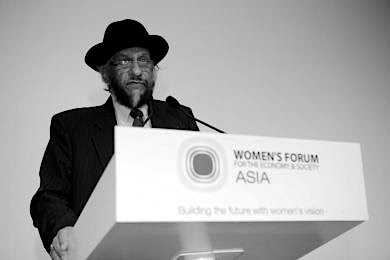
Held yesterday, the press conference was intended to calm months of uninformed conjecture—and growing concern—on the part of the evidence-based community, now leaderless. And, perhaps because he was flanked at the podium by both his wife and his girlfriend, Pachauri (who has long been admired in the West for his support for the plight of Indian women) quickly earned the twittersphere’s seal of approval. Feminist tweeters were first off the mark, noting the eco-guru’s relaxed, unthreatened demeanour in the presence of the two strong women.

While Pachauri himself is not a woman, he's long had women's backs, and the support is mutual. Unlike most male feminists, Pachauri says, he isn't just doing it to get laid, pointing out that if that were his only motive, he could think of about a hundred cons that would guarantee a higher quantity and quality of quim.

The Philogynist Wore a Fedora: While Pachauri himself is not a woman, he’s always had women’s backs—and the support is mutual. Unlike other male feminists, he assured the 2010 Women’s Forum in Asia, he doesn’t do this to get laid. If that were his game, he womsplained, there are about 100 other cons that would return a higher quantity and quality of quim for far less ass-pain. “And that’s just off the top of my head.”

Continue reading

World-class Facility Will Study How Climate Denier Thinks

“Read my lips,” climatologist Michael Mann asked a standing-room-only audience at Australia’s University of Sydney today.

He’d had us at hello, but the reverent hush of the Arrhenian Auditorium now became pin-drop silence.

“Real scientists don’t hide things,” said Mann at last, demonstrating in just five words why he’s now the hottest ticket in the rarefied, and lucrative, world of after-dinner climate-war rhetoric.

748640main_L050713_michael_mann_1000bIt was an Enlightenment cri de coeur that not only left a lump in every throat, but might have been the official theme of the day’s proceedings. We had come here from all walks of academia, every imaginable postdoctoral discipline and at least three ethnicities, but would leave inflamed by a single truth: that an existential struggle is playing out in real time, a civil war between science and unreason, glasnost and obscurantism, epistemology and agnotology, expediency and truth.

Dr Mann, who lists his area of expertise as science, was the guest of honor at today’s no-expenses-spared opening of the Wei-Hock Soon Studies Institute. The University of Sydney hopes the $20m centre will become a global hub for the investigation of the politics, ethics, philosophy, finances and activities of the eponymous climate contrarian.

Mr Soon—better known by the nom de guerre ‘Willie’—is defined by Wikipedia as “an American solar physics ‘expert’ who vociferously and often vocally disagrees with what mainstream climate science says about the science of our climate, has never been shy about his personal partisan politics, yet seems to be rather less forthcoming when it comes to the question of who pays him, how much they pay him, and what conclusions they pay him to reach.”

Read the full article by becoming a CN Inner Circle member. No need to give your credit card details—simply pass a battery of ideological litmus tests.

Science mit Dana

In today’s post I want to simplify—while expanding on—one of the biggest stories I covered at The Guardian: an exposé on the growing contrarian problem, and the threat it poses to the literary integrity of science. —D. Nuccitelli

Editing a Journal for Dummies

The Motorscooter Diaries: The author traces his crippling fear of the Earth's climate to a trip across Europe.

The Motorscooter Diaries: The author traces his crippling fear of the Earth’s climate to a gap-year trip across Europe. “As my pilgrimage puttered from Alps to Andalusia, I literally saw Nature changing in front of my eyes.”
Dana was only 19.

Help!
Someone’s submitted a paper. Should I accept it?

Probably, because it’s science.

Not necessarily, though. The power vested in you as editor, censor and gatekeeper comes with a sacred duty: to protect both the reputation of the journal, and the credibility of science itself, from injury.

That’s why you should only publish sound papers, not flawed (contrarian) ones.

What technical vocabulary do I need?

Practice the following keywords until ‘editorese’ is so natural to you that you can speak it without thinking (which is how scientists speak).

‘Sound science’ refers to the science that gets the science right, and will therefore “stand the test of time.”

(Proper science should never be provisional—i.e., subject to reëvaluation in the light of future findings. That’s a sure sign of what we call crap science.)

Synonyms for ‘sound’ include ‘mainstream,‘ ‘climate and the.’

At the other end of the spectrum there are descriptors like contrarian and flawed, which are interchangeable.

A contrarian paper is one by contrarian scientists.

(By analogy, a flawed paper is one by flawed scientistsi.e., contrarians.)

A contrarian scientist is one who thinks he knows better than previous scientists, or has ideas that conflict with, depart from, supplement, or disrespect the boundaries of, the science we currently accept.

Pro Tip for Amateurs

Unless you’re active in the field you probably haven’t kept up with the full breadth and depth of our understanding of the climate system, or what ‘the climate system’ means. So you might be wondering how you’re supposed to know if a given climate hypothesis is mainstream or flawed.

But, you’ll be pleased to know, it’s rather easy.

Climate science isn’t nearly as complex as—say—whatever you do. So far we’ve only produced one good hypothesis (AGW). So any attempt to introduce a second idea can automatically be considered contrarian, i.e. unsound.

It’s the sun? Flawed. It’s natural? Flawed. It’s not us? Flawed. It’s [insert groundbreaking explanation which, if confirmed, would force us to rethink everything we thought we knew about the drivers of terrestrial weather]? Flawed.

How good are editors at screening out flawed (‘contrarian’) science?

That’s a good question, with a precise answer. One of the fun projects I’ve been involved in—when I’m not busy raising awareness of what happens to editors who print contrarian science—is something called consensus research, which essentially tells us how well the editorial community is heeding our threats.

Last time we checked, they were being pretty careful; for every hundred papers that made it to print, only 3 were flawed.

Beyond The Stats!

You’ve probably heard the myth that the ratio of scientific papers supporting science has been stuck at 97% for several years now, with no sign of improving.

While this is true, don’t be misled by the data (a classic rookie mistake in climate science). What the myth doesn’t want you to know is that the 97% consensus is—in scientific parlance—”strengthening.” All the time.

Unfortunately, so is the dissensus. This is what gives less sophisticated readers the impression science isn’t getting more and more persuasive every year—but I don’t have to tell you how misguided that is. Barely a day goes by that researchers don’t step in a fresh lode of data consistent with everything science has been saying all along.

And here’s the killer point:

They’re obviously not mistaken in any gross way, or they would have run out of evidence years ago.

After all, we all know that nature keeps track of how much evidence it’s given to each hypothesis and immediately stops reconfirming it once scientists have got the level of empirical vindication they deserve.

(If you’ve ever wondered why experiments only work the first few times, now you know.)

So the fact that climate science still hasn’t hit its quota—that even after 26 years, new studies are still delivering the desired findings—is the most compelling proof of how true the science is, scientifically.

Sure, science is always right, as a rule, but no science has ever been this right before.

It’s no wonder then that the denialists—and pseudobelievalist accomplices like José Duarte—feel the need to disembowel consensus studies so thoroughly. It’s not as if these debunkings are novel. I don’t think any of the long litany of methodological problems they’ve “exposed” in our paper were original, or even unexpected.

I’m hard-pressed to think of any rule of science we broke that hadn’t already been broken a decade ago, by Oreskes04. (Let us know in comments if I’ve overlooked one.)

That’s why demands for the “retraction” of our “disgraceful… scam” paper are not only tedious, but disingenuous: the study in question was a slight improvement, if anything, on the unreviewed, unreviewable one-page ‘Essay’ by Naomi Oreskes that started this whole genre, back in 2004.

But if you ask a so-called skeptic, we’re the ones responsible for violating the purity of the literature. Clearly they think that, ten years after the initial defloration, it somehow “grows back.” LOL. (But then, as long as we’re denying 200 years of radiative physics, why not deny the facts of female reproductive anatomy while we’re at it?)

If skeptics aren’t hypocrites, then why aren’t we hearing [m]any calls for Science to “take one small step to restore the credibility of the climate intelligentsia” or “exhibit a modicum of editorial integrity” or “excise the cancer of pseudoscholarship that threatens not only climate science but the entire body of knowledge if it’s allowed to metastasize” by pulling Oreskes04?

The next time someone calls Cook13 an academic abomination, do what I do: rub their double standards in their face with a link to the original and best.

Digressions aside, then, the only interesting thing about the attacks on our science is the amount of overkill involved. It seems the verdict of consensuology still touches a denialist nerve—and it’s just as raw as it was a decade ago.

So if those of us on the side of the angels appear to be churning out the same study every two years, now you know why. I’m not going to pretend it’s cutting-edge science—for all I know it’s not even sciencebut it is effective.

Continue reading

America, it’s time we had a conversation about Islam

A guest post by Darrell Harb

What you didn’t know about the treasures of the Islamic mind could fill a book, but to save you buying it here’s a summary:


“Islamic science continues to advance at a rate comparable to [that of] climate science,” concluded the CIA report

We all admire our climatologists for the one scientific discovery they’ve made so far (man-made global warming, or AGW) in the short 100-to-200-year history of their field, and we hold high expectations for the sequel.

And rightly so.

Meanwhile, though, rumors of the death of Muslim science ~700 years ago have been greatly exaggerated. Scientists in the Islamic world might not be quite as prolific as they were in the Middle Ages, but they still add something to human knowledge every 50-60 years. So the next time someone identifies the United Nations’ IPCC with “the world’s leading scientists,” politely remind him or her: they’re only leading the Western world!


Jihad simply means ‘a neat way of doing something; a clever way of solving a problem.’

Scientists and mathematicians use the word all the time in the Islamic world. Deniers love to take it out of context and put a scandalous spin on it, but there’s nothing nefarious about it at all.


In 2011 a cross-disciplinary team of alchemists, algeneticists and molecular albiochemists at Cairo’s Al-Azhar University announced it had finally explained away the evolution of the eye.


Can you name the inventor of Pascal’s Wager?

Like most Westerners, you probably said Greg Craven. Surprisingly, though, the thought experiment goes all the way back to 990 AD, when the Persian philosopher Abu al-Hassan al-Amiri wrote his Kitab al-amad ‘ala’l-abad.

But unlike its craven and fallacious Christian reboot, Al-Amiri’s argument for theistic fidelity was perfectly valid.

That’s because the Koranic hell isn’t just a bad place to live. It’s a really, really bad place to live.

Considering we didn’t even have the power drill, the electric cattle prod or the industrial meat-grinder back when Allah was real, it’s a remarkable feat of the imagination. A reader has no choice but to admire His sheer inventiveness even as He details the itinerary of agony that awaits one.

For Muslims, God is 100% committed to customer excruciation. If you denialize that, you’re in store for an adventure in the receiving end of sadism that will make Abu Ghraib under Saddam look like Abu Ghraib under American occupation.

By comparison, the Bible’s attempts at eschatological blackmail “read like something written by a Batman villain’s intern,” as Megan McArdle might say.


The ‘scientist,’ Bible-basher and Qur’an-basher Richard Dawkins concedes that Jews share a common ancestor with apes but insists—contrary to what Islamic scholars discovered 1100 years before the birth of Darwin!—that they’re not directly descended from them. Prof. Dawkins’ assault on 14 centuries of science might be vindicated someday (anything’s possible) but in the meantime it should be seen as a hypothesis, not a fact, according to no less a maven than the non-Muslim Mark Maslin.


Jews “evolved from apes,” says a monograph by Prof. Maslin which goes on to confirm the existence of penicillin.

UPDATE Professor Maslin himself—doyen of climate anthropology—has weighed in and settled the origins controversy to the satisfaction of all credible people.

‘You cannot […] disbelieve that [Jewish] people evolved from apes,’ decrees Maslin, in a magisterial treatise that’s being called an overdue up-yours to Dawkins-worshipping infidelusionists (not to mention a vindication of everything Allah has been trying to reveal through our thick skulls for the last 1400 years).

In order to buy the ‘descent from a common ancestor’ cop-out [see below], logic (says Maslin) would require you to ‘disbelieve in penicillin’!

LOL!

Pray tell, my penicillin-denying conspecifics:

What exactly do you think is oozing out of yon P. notatus? What would you call that spreading slick of magic mold juice that appears to be mitigating the mitotic mojo of most microbes?

Name the fungal byproduct identified by Fleming in 1928 for its rôle in pathogenic cock-blocking. You have one minute.

Maslin won’t run from a debate. If you disagree with his science he’ll happily defend his politics.

Liquid caloric? Trimethoprim/sulfamethoxazole?

No, let me guess:

It’s The Sun, right?

Risible. And you wonder why today’s really top-notch science speakers—the Menn, the Maslins and their notch-mates—are willing to ‘Talk Politics But not Science’ with you and your ilk!

Your ilk makes me sick.


Scientists blame our irrational fear of terrorism on statistical illiteracy.

For instance, we all know that up to 3,000 Americans were killed by Islamic terrorism in the worst year, 2001; yet this death toll is minuscule when seen in proportion to the facts—facts like:

  • The post-9/11 Iraq War killed 600,000-1,000,000 innocent Iraqis. (Source: Lancet.)
  • Science expert Kofi Annan estimates climate change is killing 300,000 people each year.
  • While it’s not clear why Annan believes this, who he’s referring to or whether he has any idea what he’s talking about, uncertainty is not your friend. Far from it. The science of uncertainty (a young field pioneered by Stefan Lewandowsky) tells us that our lack of certainty actually increases the risk of Annan’s claims being true.
  • Furthermore, there were 50 million climate refugees in 2010 according to a 2005 UNEP report… and unless the world learns its lesson fast, the same humanitarian catastrophe (possibly involving the same refugees, possibly new ones; scientists aren’t sure) is scheduled to happen all over again in 2020!
  • While scientists can’t rule out the possibility that if you live in America you might be killed by Islamic terrorists, they point out you’re 4 times as likely to die every time you fly. Especially if the plane is hijacked by Muslims.
  • For each 1 (one) person who died as a result of Islamic terrorism in America last year, over 1,200 people died as a result of Islamic terrorism in the Muslim world. Yet somehow we continue to see Islam as dangerous.
  • Scientists say this is because we watch Fox.

Islamic society is surprisingly progressive on social issues! For instance:

  • Freedom of religion is a sacred right no matter which of the three you follow. In a Muslim country someone like Barack Obama would never have to pretend he was a Christian.
  • Muslims believe in the intrinsic dignity of the handicapped and are appalled by our custom, in the West, of allowing blind people to be led around by dogs.
  • The Prophet Muhammad might not have been a dog person, but he wasn’t exactly a people person either. And from the comfort of the 21st century it’s all too easy to condemn the killing sprees he led against both species. But what we forget is that back in those days, the Arab world could often be a bit of a violent place. Far from merely being a man of his times, though, Muhammad is actually considered a pioneer in the anti-discrimination movement—a patron saint, as it were—for the indiscriminate nature of his massacres.

Western science has a long way to go if it wants to catch up with Islam in understanding the denial (kufr) problem. 1400 years ago—and with greater sophistication and less confusion than the Lewandowskys and Oreskeses of the world—the Archangel Gibreel spelled out the diagnostic criteria for no less than than eight subspecies of kāfir. These classes, vividly if not lovingly described in the Holy Qur’an, correspond roughly to what we would call 1. deniers, 2. denialists, 3. disinformers, 4. misinformers, 5. contrarians, 6. skeptics, and two other types we haven’t even got names for yet!


Recent advances in telephoto lenses and robotics enable us to get a closer look at pigs than ever. And don’t worry, there’s no risk of actually touching them. Muslim scientists have now found evidence that the animal is a semi-digitigrade ungulate—and that its “trotters” are just another variant on exactly the same pentadactyl template expressed in the hands and feet of Mammalia as seemingly diverse as the monkey, the dog and the human Jew.


You probably think it was Naomi Oreskes who first imported the idea of consensus into science. Right?

That myth is understandable, given that Western science showed a complete and contemptuous lack of interest in majority opinion until 2004. But it was Islamic science, not climate science, that first abandoned evidence in favor of consensus… a full 700 years earlier! Consensus science was, in fact, the final (and therefore most triumphant) invention of the Golden Age of Islamic science and marked an abrupt transition to the current—much gentler—period of expansion in Muslim knowledge.


Another “discovery” you might attribute to Professor Oreskes is the fact that a small handful of Jews is capable of holding back an entire society by sowing uncertainty. But did you know they’d already been identified as ‘merchants of doubt’ in a ḥadīth (a collection of the Prophet’s sayings) back in the late 8th century AD?


It used to be assumed that the Koran’s advice about alcohol had something to do with the unedifying symptoms of intoxication, particularly in persons incapable of handling the piss responsibly.

This explanation was ruled out just a few years ago, when Muslim nurses at a UK hospital refused to use an alcohol-based hand wash. What their brave protest reveals is that the Prophet’s objection was not to the physiological effects of ethanol in aqueous solution, or not just to them, but to the very hydroxyl group (-OH) that defines it qua chemical compound.

Why exactly Muhammad didn’t care for the molecule is a question on which even the British nurses could offer no assistance. (But then, the guy was a couple of kangaroos short of a mob.) The extraordinary thing, however, is that he knew enough chemistry to have an opinion in the first place. Given that Western science at the time still hadn’t accepted atomic theory, the Koran’s implicit grasp of such concepts as the carbon chain, hydrogen bonds and functional groups recommends it as one of the intellectual gems of world literature.


Islam was a religion of peace, open-mindedness and moderate alcohol consumption until it was hijacked by radical extremists like the Prophet Muhammad.


About the author

Darrell Harb, an acquaintance of Climate Nuremberg’s founder, describes himself not as a Muslim but as “an objective seeker of truth who have spent my career comparing the world’s great belief systems purely on their merits.”

Dr Harb forcefully denies allegations of antisemitism, saying: “Some of my best friends are Jew! After all, I grew up on the Upper East Side [in Manhattan]—right at the heart of the global Jew machine. How could I not have Jew friends?”

Climate Nuremberg was glad to give Dr Harb an organ with which to share his (personal) take on Muslim society because it’s always been our editorial position that the more sleep you lose over Islam, the less effective you will be when it comes to worrying about real problems. Like climate change, global warming and climate disruption.
No means no: protecting yourself from Illegitimate Insertion

Guest post by Stephan Lewandowsky
Bristol University • School of Theoretical Conspiracism

In a way, today’s scientists have it better than Hypatia of Alexandria. They don’t have to worry about being flayed with sharpened stones—yet; but they do endure things no scientist should.

acclimatise-5

Victims of bullying—like climate scientists—become bullies themselves, warns Lewandowsky, who knows of several climatologists who’ve now progressed to enuresis and fire-setting.

They never signed up for this.

Nobody said their life’s work would be critically scrutinized, repositioned from fact to theory and slandered as “uncertain.”

Nobody warned them their work was going to be forcibly disclosed, competitively replicated (usually with different results), pedantically ransacked for errors and fallacies, refuted in and out of the peer-reviewed literature, ignored, investigated and cleared by two-dozen independent inquiries, debunked by amateurs of no scientific standing, and disbelieved.

(It’s the disbelief that hurts the most.)

The methods may have changed over the centuries, but whether it’s the Roman Inquisition interrogating Giordano Bruno or some head-in-the-sand blogger intimidating the ANU by asking for information, the point of questioning academics is always the same: to stifle inquiry.

Psychologists familiar with the way deniers behave have called it “bullying.” Wikipedia tells us that,

The word “bully” was first used in the 1530s meaning “sweetheart”, applied to either sex, from the Dutch boel “lover, brother” […] The meaning deteriorated through the 17th century through “fine fellow”, “blusterer”, to “harasser of the weak”.

I have an uglier term for harassment of the weak: illegitimate insertion.

When Inboxes Attack: safety tips for email recipients

Because bullying campaigns take the form of email, they can be hard to distinguish from emails.

The point of questioning academics is always the same: to stifle inquiry.

But bear in mind at all times that:

  • A real scientist will always use the email address of a reputable institution.
  • A real scientist will always state his/her credentials and repeatedly acknowledge yours, thus establishing a basis of mutual legitimacy for the interaction.
  • A real scientist will never ask for your credit card number.
  • A real scientist will seldom threaten to rape and murder your family; this is an admission of losing the argument, something proper academics rarely concede.

Deniers often take advantage of the fundamental and absolute openness that is the sine qua non of all science to disguise their attacks as requests for information.

There are, however, some subtle tipoffs. A mala fide email often gives itself away when the sender

  • claims to be a scientist but says words only a conservative would use: bitter, cling, guns, religion, Rush, Limbaugh, Popper, Feynman, etc.
  • claims to be “skeptical,” but later makes a comment that reveals detailed knowledge of your work. Remember, real skeptics know almost nothing about climate science, which is why they’re not convinced yet. But if they understand the science, that’s mens rea right there—they are (by definition) denying it.
  • has a paranoid or distrustful tone. If you sense even the slightest subtext of suspicion, this should set off major alarm bells.
  • casts aspersions on your manhood, then proceeds to hustle you with inflated claims about expensive supplements and weird exercises that just don’t work. Remember guys: if the “results” sound too good to be true, why haven’t you read about it in the peer-reviewed literature?

When people ask for your data, what do they really want?

This is a good question with no easy answers.

A Freedom of Information [FOI] request isn’t necessarily a vexatious, chilling assault on science. It probably is; but what if a legitimate scholar simply needs some data to strengthen the consensus?

Continue reading

Science for antiscientists: Knowing your enemy

Are you one of the estimated 49% of the general public, or 3% of scientists, who don’t believe what science is telling us?

That’s because you’re scientifically illiterate, say scientists. If you understood how and why science works—goes the latest thinking in the science of antiscience—you’d see how unbelievably credible it is, and immediately switch sides.

The great thing is, it’s not even subtle, complex, unintuitive, mathematical or zen. You’ll pick up how science works in five minutes, no sweat. That’s what the rest of us did.

Fun fact: a science degree is the most pointless known way of spending your college years. I discovered this the hard way. The median high school graduate already knows how science works. (That’s why we all feel qualified to take a side in the climate debate and defend it til we’re blue in the face.) Bachelor of Science, really? What species of over-schooled rube is Big Education going to unleash upon the workforce next—the Walking graduate? The PhD in Chewing Gum? The jack of all trades with a Masters in None? The English major?

Without further ado, here’s a year or so’s worth of my B.S., packed tight for your edification. (I’ve probably forgotten to cover a couple of concepts but I’ll do another post later to tie up any loose ends.)

Once you read this you’re going to feel pretty silly for spending the last 25 years angrily denouncing [what you thought was] science!


Science has been defined as “the belief in the knowledge of experts.”

Knowledge has been defined as justified, true belief ever since 369 BC, when Plato laid the groundwork for epistemology in his dialogue Theaetetus.

That’s wrong though, as the great half-geologist half-historian Naomi Oreskes revealed in 2010. Thanks to Oreskes, Western civilization now has a proper definition. Knowledge, it turns out, is “the ideas accepted by the fellowship of scholars.” Thus “we can think of scientific knowledge as a consensus of experts.”

You’ve probably heard scientists talk—obsessively—about their goal of “achieving consensus,” a phrase they borrowed from politics. But what exactly would this entail? John Cook explains:

Science achieves consensus when scientists stop arguing.

Arguing means reasoning. Substituting, we get:

Science achieves consensus when scientists stop reasoning.

With Oreskes’ discovery of the identity of consensus and knowledge, the formula reduces to:

Science achieves knowledge when scientists stop reasoning.

Why do we need science?

Continue reading

Science mit Stefan

What is the instrument by which skepticism is pursued?

Peer review.*

Peer review is literally the instrument by which scientific skepticism is pursued.

I already explained this to you.

Stephan Lewandowsky

Stephan Lewandowsky is Professor of Cognitive Psychology, but only at Bristol University. Psychology is defined as the study of the mental disorders of rats. “Brains” too, he adds [pictured].

*“Skeptics” often claim the answer is “science itself,” or “the scientific method.” Unfortunately there is no such thing, as half-scientist half-historian Naomi Oreskes has already explained (p. 80) to you.


Did You Know?

Stevan comes from a small village in Wisconsin where they say the word “pursued” instead of “um”!

Alles über Deutschland (All about Germany)

[Sent from somewhere above the Atlantic, on our way to beautiful Nuremberg.]

Five fun truths!

• In 2013 Germany celebrated 80 years of environmentally-conscious government.

• Speaking of which, scientists now believe the Holocaust was a local event, with the vast majority of hate-motivated murders from 1939 to 1945 occurring in only ~70 concentrated ‘hot spots.’

• Germany was the first EU country to sell the annual nude calendar of pro-climate scientists,* Die Konsensusfrauen (meaning the women of consent or women who say yes).

• Nobody likes Neo-Nazis. But no matter what you think of them, it’s considered offensive to accuse them of ‘Holocaust denial’ (Holocaustleugnung) now that the ECHR has ruled the term “calculatedly and hatefully evokes the spectre of climate-change denial,” rejecting as disingenuous the plea that ‘denier’ (Leugner) is merely a generic or neutral descriptor.

• On average, Germans score 125 volts higher than their US counterparts on standard tests of AQ or ‘authority intelligence’ (the ability to tell an expert from a non-credentialed source of commands).


Of course Europe as a whole was awash with human blood, but the millions of soldiers slaughtered during the period were victims of war-based (non-hate) murder.

*Yes fellas, Naomi makes a (prominent) appearance! Let us know in comments if you want a 2015 copy, but please be considerate—we’ve only got five suitcases.

“It is absolutely essential that you continue”

Half a Century of Ignoring What Scientists Are Saying

Today a student asked something that may have occurred to you, too, at some point in the climate debate:

How on earth did this happen? Who could have imagined that in the third millennium AD, in the technologically advanced Western hemisphere, there would ever prevail such an epidemic—a pandemic, even—of contempt for what scientists tell us?

What a dumb question.

The answer, of course, is Milgram.

Stanley Milgram could have imagined it.

Last year was the 50th birthday of an announcement that shocked academia… no pun intended! The work Prof. Milgram had done in the bowels of the Yale University Psychology Department revealed for the first time the sheer depth of Middle America’s disrespect for scientific authority.

Continue reading